CISN - The OMICS Revolution and Beyond - Personalized Medicine - pg 8
| You Are Here: Home > Cancer Research > What We Know About Cancer > OMICS Revolution > Personalized Medicine - pg 8 | ||
Personalized Medicine - page 8Challenges of Implementing Personalized MedicineThe science is not yet ready for everyday use. Even once the science has been perfected, the successful implementation of personalized medicine is dependent upon several factors.
|
| Section Index | |
| ● | What We Know About Cancer |
| How Cancer is Studied | |
| Drug Development | |
 |
New Treatments |
| Research Advocacy | |
Personalized Medicine Depends on Biospecimen (tissue) DonationPersonalized medicine for cancer is in many cases still a vision for the future. For it to become a greater reality, cancerous and normal biospecimen samples will need to be:
Based on this information, a patient will be treated with therapies or approaches that target the cancer preferentially, while sparing normal tissue. For more information about
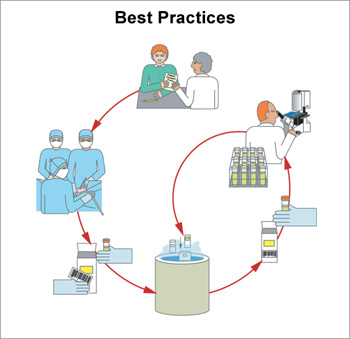
the importance of tissue donation from CISN go to: Standardization of Biospecimens is Crucial to Success1. Patient Consent Health professionals explain to the patient that their tissue donation is very important to accelerating progress in cancer research. If / when permission is given, the consent form is archived carefully and uniquely linked to the sample. Advocates can play a role in this process by educating the public about the importance of tissue donation. This is an individual's choice and although the progress of personalized medicine depends on tissue collection, no pressure should be brought by either advocates and/or doctors to influence a person in their decision. The consent document needs to be understandable to the person being approached with implications for future use and confidentiality/privacy clearly explained. 2. Sample collection
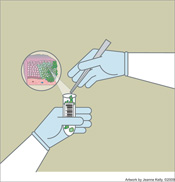
It is critically important to understand how to collect cancer biospecimens properly, so that the information obtained from analyses, using approaches such as genome-wide profiling, are correct and not artifacts of mishandling. 3. Obtain and Stabilize Sample A biospecimen is removed from the patient, taking great care to keep the sample biologically viable. These steps need to be standardized across the Country so in research, samples can be compared against each other to determine normal values and in the clinic, so values reported out to patients are valid and can be reproduced wherever that patient goes for treatment. 4. Attach unique identifier A unique identifier is associated with the biospecimen. Unique identifiers link the tissue sample with its relevant annotated records, so future results from studies using this sample can again be associated with the original patient donor. Confidentiality must be adhered to. 5. Store carefully A biospecimen is carefully stored in a location that monitors temperature and conditions to properly support the integrity of the tissue. 6. Retrieve and re-store carefully When needed for analysis, a biospecimen is carefully retrieved, and if any sample remains afterward, it is re-stored with care. 7. Best Practices
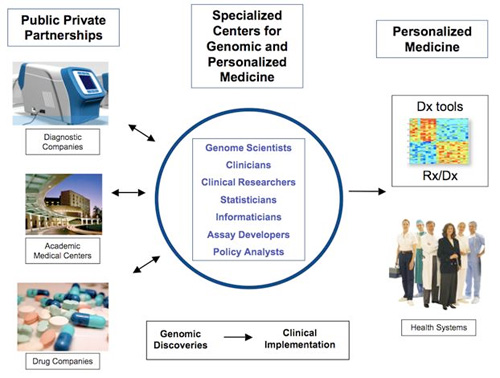
For more details on the best practices in biospecimen collection please see: Examples of Large Personalized Medicine ProgramsWe have listed several large-scale personalized medicine programs below to demonstrate work in progress. As you read through them you learn that there is quite a variety of approaches, some more broad than others. 1. The Coreill Personalized Medicine Collaborative CPMCT is enrolling individuals in a research study to investigate the impact of personalized medicine on health outcomes.
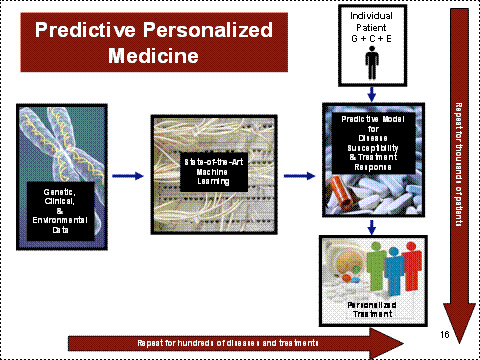
As of 2011, the CPMC are enrolling participants into wellness and cancer arms. Close partnerships with area hospitals are designed to catalyze physician engagement in personalized medicine. 2. The Personalized Medicine Coalition published the second edition of 'The Case for Personalized Medicine' in May 2009. This report details how personalized medicine plays an increasingly integral role in delivering high-quality, cost-effective healthcare and presents evidence that personalized medicine will continue to grow in importance as scientific breakthroughs are translated into a new generation of targeted therapeutics. For more about this coalition go to: http://www.ageofpersonalizedmedicine.org/index.asp 3. Wisconsin Genomics Initiative (WGI) On October 10, 2008, Wisconsin Governor Jim Doyle announced the Wisconsin Genomics Initiative, which is a collaborative research effort among Marshfield Clinic, Medical College of Wisconsin, University of Wisconsin School of Medicine and Public Health, and University of Wisconsin-Milwaukee. The vision of WGI is to be able to predict for individual patients in a clinical setting the
risks of disease susceptibility and treatment response using the combined power of cutting-edge genetic, phenotypic, and environmental analyses, thereby making the
The key elements of the WGI strategy are to:
4. Partnership for Personalized Medicine (PPM) PPM is a nonprofit initiative whose goal is the development, validation and clinical application of new molecular diagnostics designed to improve health outcomes and, importantly, reduce health care costs. The Partnership for Personalized Medicine is led by Dr. Lee Hartwell, President and Director of the Fred Hutchinson Cancer Research Center and 2001 Nobel laureate; Dr. Jeffrey Trent, President and Scientific Director of the Translational Genomics Research Institute (TGen); and Dr. George Poste, Director of the Biodesign Institute at Arizona State University. |

|