CISN - The OMICS Revolution and Beyond - Personalized Medicine - pg 3
| You Are Here: Home > Cancer Research > What We Know About Cancer > OMICS Revolution > Personalized Medicine - pg 3 | ||||||||
Personalized Medicine - page 3
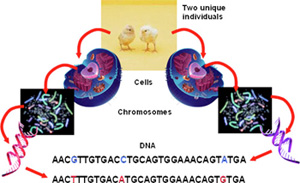
The information on genomic mutation and variation promises to revolutionize the processes of finding correlations for disease-associated gene sequences. There are many different types of genetic mutations. One of the types now being extensively studied is a type of genetic variation. Simply speaking, variation is difference. It's what makes you "you".
In the image above if the top sequence of DNA is considered normal, then the bottom strand shows 3 single nucleotide changes in the DNA (all in red). These would be called single-nucleotide polymorphism (SNPs) and may or may not produce a problem in this chick. Scientists have identified about 1.4 million locations where SNPs mutations occur in humans. When SNPs occur within a gene or in a regulatory region near a gene, they may play a more direct role in disease by affecting the gene's function. SNPs are now thought to be key enablers in realizing the concept of personalized medicine. Doctors may one day obtain a test that shows an individuals SNP profile. From this profile, they may know which drug an individual needs and will respond to.
Early in cancer research, it was thought that all cancers began as mutations caused by mistakes in the genes. Researchers now know that cancer can occur with no mutations to the DNA, however, the DNA itself is modified, without changing the underlying genetic code. It is these epigenetic "marks" that tell your genes to switch on or off, or to what intensity. It is through epigenetic marks that environmental factors like diet, stress and prenatal nutrition can make an imprint on genes. Unlike genetic damage, epigenetic changes can sometimes be reversed. |
||||||||
| Section Index | |
| ● | What We Know About Cancer |
| How Cancer is Studied | |
| Drug Development | |
 |
New Treatments |
| Research Advocacy | |
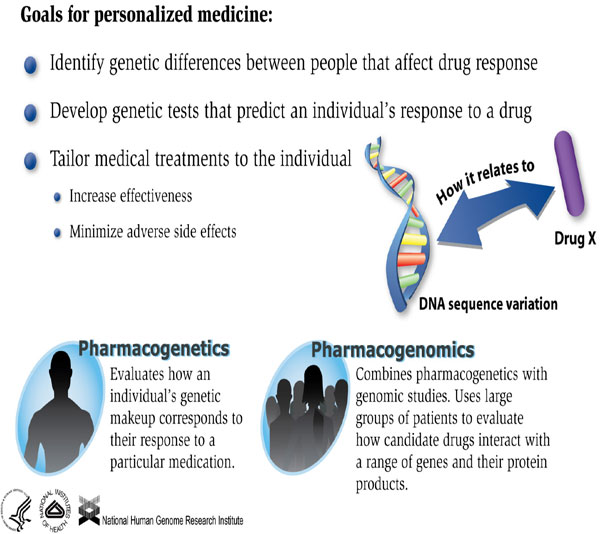
Pharmacogenomics (a specialty field within the study of genomics) is generally regarded as the study of genetic variation that explains why some people respond to certain drugs while others do not. Pharmacogenomics uses information about a person's genetic makeup, or genome, to choose the drugs and drug doses that are likely to work best for that particular person.
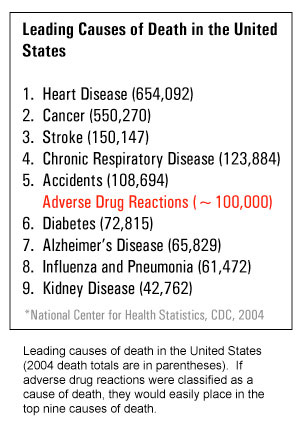
Much of current clinical interest is at the level involving variation in genes involved in drug metabolism, with a particular emphasis on improving drug safety in people. We now know that there are: Rapid or slow metabolizers (how long the drug stays in your body) but also responders and non-responders (does the drug work for you). It has been estimated that there are more than two million occurrences of serious side effects from drugs each year in the United States, which may lead to more than 100,000 deaths per year.
The avalanche of genomic data grows daily. The new challenge will be to use this vast reservoir of data to explore how DNA and proteins work with each other and the environment to create each individual. |
|