CISN - The OMICS Revolution and Beyond - Personalized Medicine - pg 4
| You Are Here: Home > Cancer Research > What We Know About Cancer > OMICS Revolution > Personalized Medicine - pg 4 | ||||||
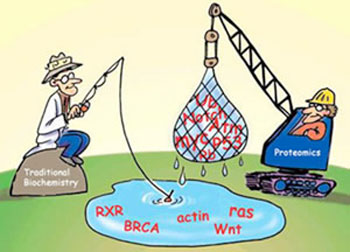
Personalized Medicine - page 42) Proteomics Proteomics looks for patterns among proteins. The term "proteomics" was first coined in 1997 as an analogy with genomics, the study of the genes. The word "proteome" is a blend of "protein" and "genome". The proteome is the entire complement of proteins, including the modifications made to a particular set of proteins, produced by an organism or system. This will vary with time and distinct requirements, or stresses that a cell or organism undergoes. While genes are the 'recipes' of the cell, containing all of the instructions for assembly, proteins are the products of these recipes, functioning as the cellular "engines" that drive both normal and disease physiology. "So while genomics may provide the likelihood of developing a certain disease, proteins may diagnose what is happening in a patient in real time. Together, these complementary fields (genomics and proteomics) are absolutely necessary for understanding the molecular underpinnings of disease and for enabling personalized medicine." Quote from National Cancer Institute
|
||||||

| Section Index | |
| ● | What We Know About Cancer |
| How Cancer is Studied | |
| Drug Development | |
 |
New Treatments |
| Research Advocacy | |
However, proteomics is much more complicated than genomics. This is because while an organism's genome is more or less constant, the proteome differs from cell to cell and from minute to minute depending on the activity of specific genes. This makes interpreting a protein measurement difficult. Whereas genomic studies of cancer usually require tumor tissue, proteomic studies mostly look at proteins circulating throughout the body. So these studies can be conducted using blood, urine or other body fluid samples.
A breakthrough in cancer treatment was the discovery that tumors "leak" proteins and other molecules into blood, urine, and other accessible bodily fluids. This insight has led to the possibility of diagnosing cancer at an early stage simply by collecting such fluids from patients and testing them for the presence of cancer-related molecules, also called "cancer biomarkers/tumor markers". The greatest promise for the early detection and treatment of cancer lies in the ability to find valid molecular indicators, or biomarkers, of the disease.
Although protein biomarkers hold great promise in our fight against cancer, there are significant challenges that must be overcome:
Summary: Diseases such as cancer, while based on genomic mutations, show up as problems in protein signaling. Pharmaceutical interventions aim to fix the faulty protein activity, not the genetic defect. 3) Metabalomics Metabolomics is the systematic study of the unique chemical fingerprints that specific cellular processes leave behind. More specifically, it is the study of metabolic responses to drugs, environmental changes and diseases. Metabolomics is an extension of genomics (concerned with DNA) and proteomics (concerned with proteins). Following on the heels of genomics and proteomics, metabolomics may lead to more efficient drug discovery and individualized patient treatment with drugs, among other things.
|
||||||||||||||||||

|