CISN - How Cancer is Studied - Translational Research
| You Are Here: Home > Cancer Research > How Cancer is Studied > Translational Research > Translational Research | ||||
Translational ResearchOverviewIt is important to recognize that one type of research is not better than another, they just have different goals. We have already discussed that the goal of basic research is to gather data and to discover new knowledge. This new knowledge can then be used to provide (translate) better healthcare solutions to people by bringing experimental ideas into animal models to begin to test if they are effective.
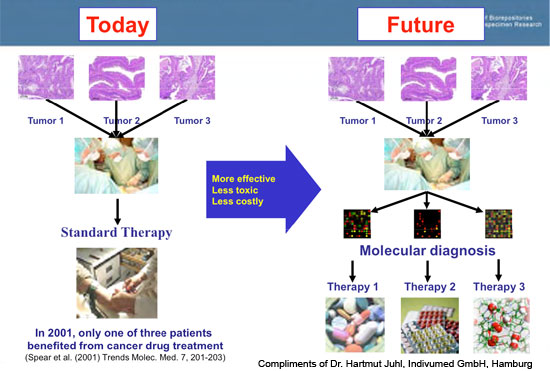
Pharmaceutical and biotechnology companies along with the NIH have been pouring a lot of money into basic research and they are now realizing that the return on their investment is not living up to expectations, possibly because there was limited structure in place to move promising ideas into the clinic quickly. Translational research is now seen as being the key missing component. With its focus on removing barriers to multi-disciplinary collaboration, translational research has the potential to drive the advancement of molecular-based medicine and fulfill the promise of personalized medicine. The possibilities inherent in using biomarkers to predict, detect, and monitor disease make the concept of personalized medicine tangible but it can be realized only when clinicians, researchers and the various operational staff can work together effectively. |

| Section Index | |
| What We Know About Cancer | |
| ● | How Cancer is Studied |
| Drug Development | |
 |
New Treatments |
| Research Advocacy | |
To fully implement this vision, translational research requires researchers and clinicians to have ready access to two critical types of information:
New belief systems and structures are neededCollaboration between researchers, data sharing, data integration and standards are integral to translational research. Only by seamlessly structuring and integrating these data types into one whole will the complex and underlying causes and outcomes of disease be revealed, and effective prevention, early detection and personalized treatments be realized. This is a departure from the process of basic research in which each researcher usually works independently and only shares discoveries through publication of results. To take an idea from concept through publication takes many years during which only a few people have access to this work. Translational research demands that researchers and clinicians work in a collaborative, multidisciplinary approach, sharing as they discover. This newer approach of more collaboration is now being utilized in all stages of the research process. The 'NIH Roadmap' is a project that is attempting to assist in these efforts.
The image is from a recommendation report to the NCI from the NCI Translational Research Working Group. It illustrates the steps involved along the translational pathway. For more information on the
NCI roadmap: |

| |
|