CISN - How Cancer is Studied - Correlative Science pg. 2
| You Are Here: Home > Cancer Research > How Cancer is Studied > Translational Research > Correlative Science pg. 2 |
Correlative Science - page 2Clinical Applications of Correlative Science - cont.Leadership is needed in the following areas
|
| Section Index | |
| What We Know About Cancer | |
| ● | How Cancer is Studied |
| Drug Development | |
 |
New Treatments |
| Research Advocacy | |
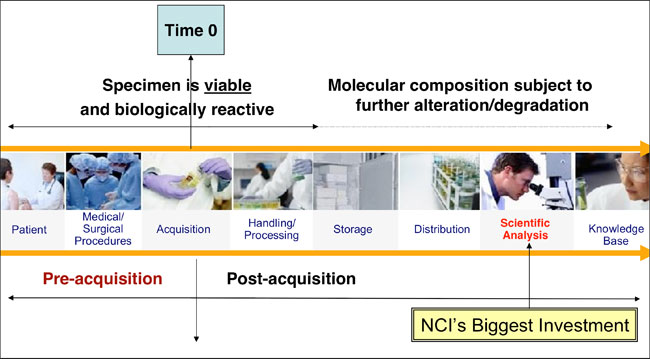
The image below depicts the various steps that a tissue sample must undergo: from the patient through collection, processing, storage and analysis. It is hoped that this process will provide answers that help patients in the future. Image courtesy the National Cancer Institute.
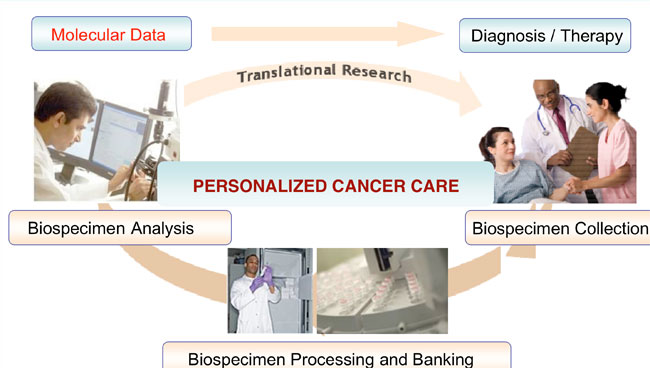
The Future of Correlative scienceThe promise of genomic and personalized medicine lies in the ability to forge a connection between patient clinical data and scientific measurements on collected biospecimens such as the results of a SNP, transcriptional profile, or sequencing assay. Research is shifting toward focus on molecular profiling, in which specific assays are conducted on large numbers of diseased and normal specimens to aid in the search for genetic, protein, and transcriptional clues to the origin and pathways of disease. Because of this trend, the need for integration of large amounts of clinical data with scientific results has become critical to the process of identifying the criteria for subpopulations that may best benefit from a new drug or treatment. Long-term longitudinal studies, such as government-managed biobanks, in which populations are followed for a long periods of time to uncover population trends, require the ability to operationally track millions of specimens.
Many pharmaceutical companies are also creating patient registries, which are prospective banks of large numbers of samples from particular patient populations. Companies hope to examine genetic or transcriptional trends that may yield clues to potential treatments or drug response profiles. Together, these trends have increased the number of samples that have been collected for the purpose of discovery. Correlative Science ProjectsWe have only included a couple of projects below but many individual cancer centers, universities and commercial companies have projects/programs already in place.
The Office of Biorepositories and Biospecimen Research (OBBR) was established in 2005 in recognition of the critical role that biospecimens play in cancer research. The OBBR is responsible for developing a common biorepository infrastructure that promotes resource sharing and team science in order to facilitate multi-institutional, high-throughput genomic and proteomic studies. OBBR has published guidelines for the standardization of collecting, processing and testing patient tumor samples. For more information see: http://biospecimens.cancer.gov
caHUB is a unique, centralized, non-profit public resource sponsored by the National Cancer Institute that works to ensure an adequate, continuous supply of human biospecimens and associated data that is measurable, high quality and acquired within an ethical framework. Funding:The following is copied from the NCI site and is used as an example of one funding mechanism that is encouraging biomarker exploration. "PA-08-134 Expiration Date: May 8, 2012 This Funding Opportunity Announcement (FOA) is intended to support translational correlative studies that utilize annotated tumor and/or other biospecimens collected during large-scale multiinstitutional clinical and/or prevention trials, respectively. The Cancer Therapy Evaluation Program (CTEP), the Cancer Diagnosis Program (CDP), and the Cancer Biomarkers Research Group (CBRG) of the NCI are cooperatively sponsoring this FOA with the overarching goal to facilitate predictions of responses to current interventions, and inspire future development of improved therapeutic and preventive strategies. Projects proposed in response to this FOA should address:
CISN Summary
|
1 2 |
|