CISN - Where does Personalized Medicine Stand Today?
| You Are Here: Home > Personalized Medicine > Personalized Medicine & You > Making it Personal > Promise > Challenges > Where does Personalized Medicine Stand Today? |
|
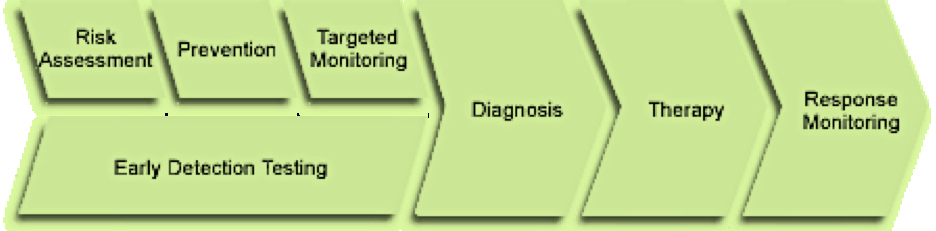
Personalized Medicine & YouWhere does Personalized Medicine Stand Today?If you were to ask your Primary Care Provider (PCP) this question, your answer would include information on your symptoms, lab test results, lifestyle, environmental exposures, and possibly the molecular biomarkers for your specific cancer. However, should you ask your Oncologist this same question, much of the information youll receive will concern molecular biomarkers. Since you located this site based on your interest in cancer, we will focus on biomarkers in this section. The arrow below illustrates the many different areas that may be affected by using biomarkers in personalized medicine.
Image from the Personalized Medicine Coalition We will briefly discuss all of these areas below and will cover them each in more detail as you move through this section of our website. Early Detection TestingAs shown in the diagram above, early detection testing includes Risk Assessment, Prevention, and Targeted Monitoring. Although early detection testing will continue to be based on the risk averaged from a large population sample, the hope is that new tools will enable screening tests such as mammograms and colonoscopies to be more accurate and find disease earlier when it is easier to treat. Risk AssessmentNew forms of risk assessment will determine which people carry a genetic variation that may increase their risk for developing cancer. Enhanced means of 16 risk assessment will improve the ability to make informed life choices that may decrease a persons risk. When individuals are found to have known variations, they should be monitored more closely based on evidence-based guidelines. |
| Personalized Medicine & You |
|
| Understanding Tissue Issues |
|
| Ethics | |
| Molecular Diagnostics |
|
| Prevention Although our genes influence our risk for cancer, much of the difference in cancer risk is due to factors that are not inherited. Although there is little you can do if you do have a specific genetic mutation, there are still steps that you can take to reduce your risk of developing cancer. Such measures include avoiding tobacco products, keeping a healthy weight, staying active throughout life, and eating a healthful diet, all of which may reduce a persons lifetime risk of developing cancer. These same behaviors are also associated with a lower risk of developing heart disease and diabetes.
Although we all have the ability to make healthy choices, the social, physical, and economic environments in which we live may positively or negatively impact our ability to stick with our well-intended plans. Nevertheless, is it important to realize that you are in control.4 Targeted monitoring Personalized medicine introduces the ability to use markers that may signal risk or detect disease before symptoms appear. Women with certain BRCA gene variations have an increased risk of developing breast cancer. Increasing the frequency of mammograms may be recommended to help early detection, or preventive surgery or chemoprevention may be considered for possible risk reduction. Genetic markers are also currently being used to facilitate safer and more effective drug dosing and scheduling.3 DiagnosisFulfilling the promise of personalized medicine requires that these findings be translated into precise diagnostic tests and targeted therapies. In current practice, cancer diagnosis is primarily based on symptoms (clinical presentation) and by your pathology report. New molecular tools may help to characterize cancer subtypes that cannot currently be distinguished clinically and may provide predictive information concerning disease outcome, aiding in guiding treatment decisions. Below are types of testing now being used to provide your doctors with the information they need to make an accurate diagnosis of your cancer type and stage. Hereditary Gene Testing Personalized medicine is being used today in the testing of inherited genetic mutations. For example, specific BRCA1 and BRCA2 gene mutations are implicated in familial breast and ovarian cancer. Genetic testing can be provided to determine individuals at increased cancer risk due to such BRCA mutations, which may prompt more intense monitoring and consideration of prophylactic therapy. Somatic Gene Testing Personalized medicine is now being used to detect somatic or non-inherited mutations in cancer. Somatic mutations refer to acquired gene mutations or DNA changes that occur after conception. Some examples are the following:
Diagnostic testing a few examples
TherapyNew molecular tools may also provide doctors with information on which drugs their patients may or may not respond to and/or the likelihood of their developing adverse effects associated with certain agents. Targeted Therapy Targeted therapy is the use of agents designed to target specific mutated molecular pathways in a subset of patients with a given cancer type.
Examples include the following:
As a result, people with such DPD mutations have a higher risk of developing severe or even fatal reactions to 5-FU. Screening for DPD mutation and direct measurement of DPD activity prior to treatment with 5-FU will enable proper adjustment of dosage to prevent a dangerous adverse reaction. Response MonitoringTo truly wipe out cancer cells within the body, it is not enough to have effective drugs that target some of the cancer growth pathways. It is important to have a way of monitoring the cancer itself, so that drug therapy can be adjusted should the tumor change or evolve. Response monitoring may be done by measuring tumor markers (biomarkers).
|
|||||||||||||||||||||




 |