CISN - Cancer Research - Genetic Structure - pg.7
| You Are Here: Home > Cancer Research > What We Know About Cancer > Basic Cancer Biology > Genetic Structure - pg.7 | ||
CISN Summary of Genetic Structure:The DNA Code - is made up of very long chains of four chemical bases or ‘letters’ - A (adenine), G (guanine), T (thymine) and C (cytosine.)
DNA
|

| Section Index | |
| ● | What We Know About Cancer |
| How Cancer is Studied | |
| Drug Development | |
 |
New Treatments |
| Research Advocacy | |
Genes
ChromosomesChromosomes are large DNA molecules composed of two chemical strands that are twisted around each other to form a "double helix." We each have 23 pairs of chromosomes - 22 pairs are identical or autosomal and the 23rd pair is a set of sex chromosomes (XX=female / XY=male). RNARNA is one of the two types of nucleic acids found in all cells. RNA uses a different base pairing rule than DNA:
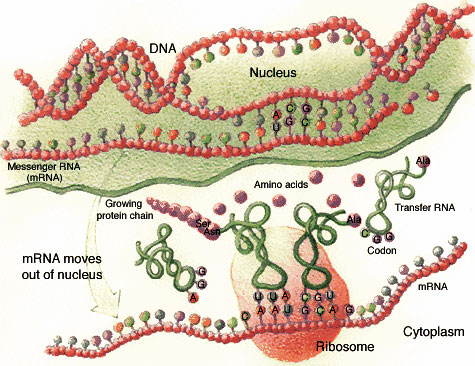
In the cell, RNA is made from DNA (the other type of nucleic acid), and proteins are made from RNA. ProteinsProteins are assembled from amino acids using information encoded in genes. Proteins are the basis of body structures such as skin and hair and of substances such as enzymes, cytokines, and antibodies. Genes to mRNA to Proteins - Explanation of the image belowWhen a gene expresses itself, it "switches on" to produce a protein. The gene does so by first directing the synthesis of an intermediary molecule called messenger ribonucleic acid (mRNA).
GenomeEvery organism, including humans, has a genome that contains all of the biological information needed to build and maintain a living example of that organism. The biological information contained in a genome is encoded in its deoxyribonucleic acid (DNA) and is divided into discrete units called genes. Genes code for proteins that attach to the genome at the appropriate positions and switch on a series of reactions called gene expression. The "Central Dogma""DNA makes RNA, RNA makes protein, and proteins make us." Francis Crick
We have provided background information about cells, the cell cycle and genetic structure to help you understand the normal process of each of these components. We have a little more basic information to provide and then we will move to the disruption of the normal process that leads to cancer. |
||||||||

|